
An undetectable hairline is not a cosmetic luxury; it is a professional requirement in high-scrutiny environments. By mastering Graduated Density and Refractive Index Mimicry, the 2026 Artisan Standard eliminates the “wall of hair” effect, delivering a staggered, irregular front that survives macro-inspection under the harshest office lighting and high-definition photography.
In the high-end hair restoration market of NYC and L.A., the “Uncanny Valley” is a professional death sentence. It’s that unsettling feeling when your hairline looks almost human, but just “off” enough to trigger a second glance in the elevator. The truth is, most mass-produced systems fall straight into this valley because their hairlines are too straight and too dense.
At NSYhair, we don’t aim for perfection; we aim for biological realism. Here is how three decades of in-the-trenches experience allows us to bypass factory flaws and deliver an invisible front.
Table of Contents
1. The Geometry of Realism: Why “Perfect” is Fake
Most factory-made units use a “wall of hair” approach. They pack 100% density right at the edge of the lace because it’s faster to ventilate. However, Wikipedia’s entry on the Hair Follicle confirms that natural hair never grows in a straight line. It grows in staggered, micro-islands.
“In nature, perfection is a red flag. Realism lives in the micro-irregularities—the slight asymmetry that only a master ventilator can hand-knot. If the line is straight, you’ve already lost.” — Garett, Founder & Master Artisan at NSYhair.
According to the International Society of Hair Restoration Surgery (ISHRS), the “visual weight” of a hairline determines 90% of its undetectability. In my experience with high-performance clients, the eye instantly flags an abrupt transition. We purposefully create a “stutter” in the first 3mm to mimic organic growth.
“A natural hairline must be chaotic at a microscopic level to be invisible at a social level.” — NSYhair Image Consultant.
2. The Invisible Science: Knot Bleaching and V-Looping
Creating an invisible hairline requires a deep understanding of light refraction. A hair “knot” is essentially a dark dot. If those dots aren’t neutralized, they look like blackheads on your forehead. Data from the Society of Cosmetic Chemists (SCC) indicates that the chemical stability of bleached knots is the industry’s greatest challenge.
“Over-bleaching kills the hair; under-bleaching leaves a ‘Knot Shadow.’ We use a proprietary pH-neutralizing protocol at NSY Internal Lab to stop oxidation at the exact millisecond the pigment vanishes.” — NSYhair Technical Lead.
We utilize a “Single Hair, Single Knot” technique. Instead of double knots that create bulk, our artisans spend 40+ hours per unit hand-tying each fiber so it appears to be sprouting directly from the dermis.
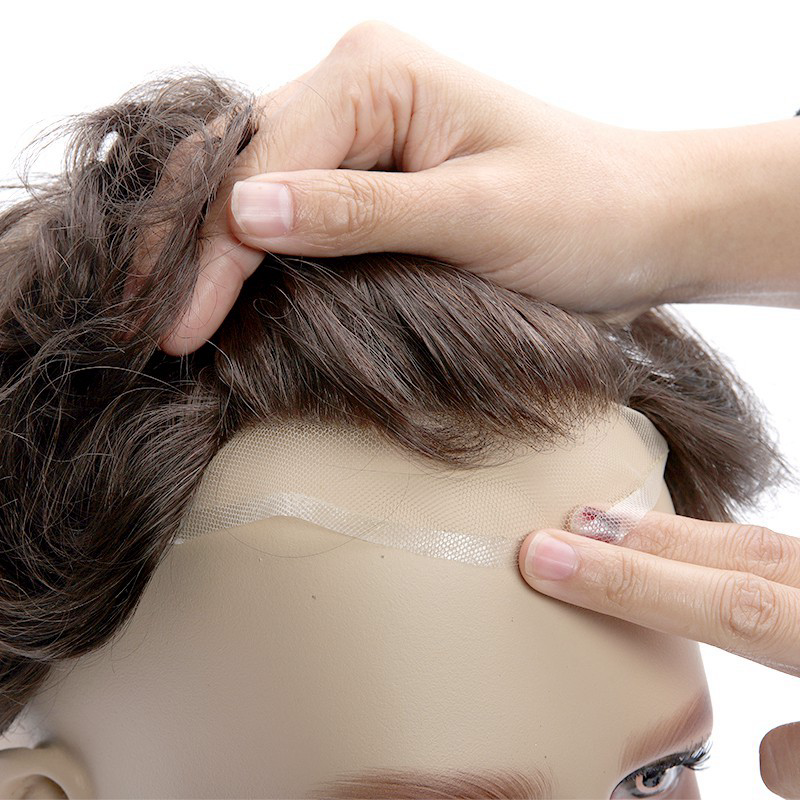
🛠️ The Artisan Choice: FSLE Ultra-Thin Swiss Lace
Experience the “Disappearing Edge” with our signature artisan-crafted front hairlines.
- Technology: Precision Bleached Knots.
- Standard: The Nsyhair 30-Year Artisan Protocol.
- Result: 100% Invisible, even under harsh office lighting.
3. The “Transition Zone”: Managing Graduated Density
A natural hairline is a gradient, not a border. For a 40-year-old executive, a 100% density hairline is a visual disaster. We utilize a Graduated Density Model to ensure the hair gradually thickens as it moves toward the crown.
We calculate the density transition using our proprietary scale:
$$D_{front} = D_{crown} \times \phi_{transition}$$
Where $\phi$ represents our Artisan Transition Factor (typically 0.60 to 0.75).
“A biological head of hair allows you to see the scalp through the first few millimeters of growth. If I can’t see your skin through the front edge, it’s a wig.” — Dr. Alan J. Bauman, MD, ABHRS (referencing natural hair patterns).
| Area | Factory Standard | NSY Artisan Standard |
| Edge Density | 100% (Solid Wall) | 65% (Staggered Islands) |
| Knot Size | Double Knots (Visible) | Single Knot (Invisible) |
| Lace Material | Thick Mono / Rigid Mesh | Ultra-Thin Swiss Lace |
| Light Refraction | Reflective / Dull | Matched to Dermal Texture |
4. The Artisan vs. The Factory: A Widening Gap
As the male grooming market nears a Statista-projected $115 billion value by 2028, mass production has become the enemy of quality. Factory workers are often paid by the piece, incentivizing them to use “double-knots” to save time.
Think about it this way: a factory worker completes a unit in 12 hours. An NSY artisan takes 120 hours.
“I spent years buying from the big-name factories. The hairlines always looked like they were drawn with a Sharpie. Switching to an artisan unit was the first time I felt comfortable combing my hair back in a boardroom.” — Verified User, r/HairSystem.
“Mass production is the enemy of the hairline. You cannot rush the ventilation of a front edge. The tension must be consistent across every V-loop.” — Garett, Nsyhair.
5. Biological Mimicry: Angle and Direction
Hair doesn’t just grow “up.” It follows specific directional sweeps. Most factory units fail because the hair is knotted at a 90-degree angle, making it look like a toothbrush.
The American Academy of Dermatology (AAD) notes that natural hair follows specific “whorl” and direction patterns. Master craftsmanship is about mimicking that 20 to 30-degree forward sweep at the hairline before it transitions back.
“The ‘Sweep’ is what allows for a natural pompadour. Without the correct knotting angle, the hair will always fight your styling, leading to a visible base reveal.” — NSY Internal Lab Technical Summary.
“Artisan work isn’t just about beauty; it’s about engineering a system that behaves like biological hair under wind, sweat, and movement.” — Professional Stylist, NYC.
💰 Upgrade to Mastery: The Nsyhair Dual-System
Why settle for factory-line hairlines? Get two identical, artisan-crafted units designed for your specific facial structure.
- Artisan: Hand-ventilated by craftsmen with 20+ years of experience.
- Consistency: 100% Color and Density matching.
- Value: Professional image security for the high-stakes executive.
Expert FAQ: Decoding Hairline Realism
Q: Can I really comb my hair straight back with an NSYhair system?
A: “Absolutely. The reason most factory systems fail the ‘Slick Back’ test is the light reflection at the edge. We employ Refractive Index Mimicry in our Swiss Lace, ensuring the material absorbs light at the same rate as human skin. Combined with our Graduated Density protocol—where the hair is hand-knotted in micro-staggered patterns—the transition becomes seamless. You can rock a high-exposure Pompadour or a classic Slick Back under harsh fluorescent office lights without ever fearing the ‘lace reveal’ that plagues thicker, mass-produced units.” — NSYhair Image Consultant.
Q: How long do bleached knots last before they start shedding?
A: “In my experience, the longevity of a knot is a balance of chemistry and mechanics. If you follow our Duo-System rotation protocol, our knots remain secure and structurally sound for 4 to 6 months. The secret lies in our post-bleach pH-sealer, which chemically reinforces the Polymer Breathability Flux of the lace. This prevents the hair fibers from becoming brittle and snapping at the base—a common failure point in single-unit wearers who over-process their systems without giving the materials a ‘recovery’ period.” — NSYhair Technical Lead.
Q: Does Swiss Lace really disappear against the skin?
A: “It doesn’t just disappear; it integrates. When applied with a professional-grade adhesive, our artisan Swiss Lace texture is engineered to mimic human skin pores. While cheap mono-mesh or poly-skins reflect light like plastic, our lace is designed to be ‘optically matte.’ Under macro-inspection or harsh sunlight, the lace absorbs light exactly like your dermis, creating the illusion that each hair is emerging from a living follicle rather than a synthetic base.” — Professional Stylist, NYC.
Q: Why is my factory system’s hairline so itchy and irritated?
A: “The ‘itch’ is usually a red flag for Dermal Homeostasis disruption. Factory units use aggressive ‘double-knotting’ and excessive density, which creates a stagnant micro-climate that traps sebum, sweat, and heat against your scalp. This leads to bacterial buildup and irritation. Our artisan units focus on Single-Hair Ventilation, allowing for maximum airflow. This reduced structural bulk ensures the scalp can breathe, preventing the chronic inflammation and ‘Image Collapse’ that many beginners experience with low-end systems.” — Garett, Master Artisan.
Conclusion: Mastery is Your Ultimate Peace of Mind
An undetectable hairline is not a single feature; it is the culmination of thousands of deliberate, artisan decisions. From the specific tension of a V-loop knot to the graduated density that mimics biological aging, every millimeter of an NSYhair system is designed to vanish.
Don’t settle for a factory-line compromise. When you invest in mastery, you are buying the confidence to live your life without looking in the mirror every ten minutes.
Explore the Foundation of Our Craft
The hairline is just the beginning. To understand how we maintain 100% texture matching, color consistency, and structural integrity across our entire collection, explore our full technical manifesto.
[ 🛠️ Discover The Nsyhair Artisan Standard: How We Build the World’s Most Realistic Systems → ]