
To ensure maximum scalp health, Nsyhair utilizes Moisture Vapor Transmission Rate (MVTR) testing to measure how efficiently our Dual-System bases dissipate heat and perspiration. By optimizing mesh porosity and polymer thickness, we ensure our systems provide a 24/7 “oxygen window.” This clinical-grade airflow prevents follicle suffocation and maintains a stable scalp microbiome, even in high-performance environments.
For the active American professional, a hair system shouldn’t feel like a thermal barrier—it should feel like an extension of the skin. According to the International Association of Trichologists (IAT), persistent heat trapping on the scalp is the leading cause of inflammatory skin conditions among prosthetic wearers. In 2026, we don’t just claim comfort; we measure it in the lab.
Table of Contents
1. The “Scalp Suffocation” Myth: Why Breathability is a Health Metric
Many budget hair systems act like a plastic wrap, creating what dermatologists call the Occlusive Effect. This effect traps sebum, heat, and moisture against the dermis, leading to a spike in scalp temperature.
If your scalp cannot “breathe,” your hair follicles are effectively suffocated by their own secretions. This isn’t just an “itch” issue—it’s a clinical health risk. High-quality ventilation is the only way to prevent the chronic redness and yeast buildup common in single-unit “permanent” wearers.
2. The Vapor Transmission Test: How We Measure Airflow
In textile engineering, “Breathe-ability” is quantified by the Moisture Vapor Transmission Rate (MVTR). This measures the mass of water vapor that passes through a square meter of material over a 24-hour period.
$$MVTR = \frac{m}{A \cdot t}$$
Where $m$ is the mass of water vapor, $A$ is the area, and $t$ is the time ($24$ hours).
Key Stat: While a standard “budget” poly-skin base from a mass-market retailer often scores below $400 \text{ g/m}^2 \text{/24hr}$, an Nsyhair Artisan Swiss Lace base achieves an MVTR of over $2,800 \text{ g/m}^2 \text{/24hr}$. This represents a 7x increase in evaporation efficiency.
3. The Thermal Conductivity Factor: Staying Cool in the US Heat
From the humidity of Miami to the dry heat of Arizona, thermal regulation is paramount. Data shared on the r/HairSystem community on Reddit confirms that “Heat Dissipation” is the #1 factor in wearer satisfaction.
Key Stat: Research in Textile World shows that for every $1^\circ\text{C}$ increase in scalp temperature, the rate of anaerobic bacterial growth can spike by $15\%$.
“A breathable base acts as a heat sink. By using specialized hand-knotting techniques, we create microscopic ‘ventilation chimneys’ that allow heat to escape vertically while the adhesive stays anchored horizontally.” — Garett, Founder & Master Artisan at Nsyhair.
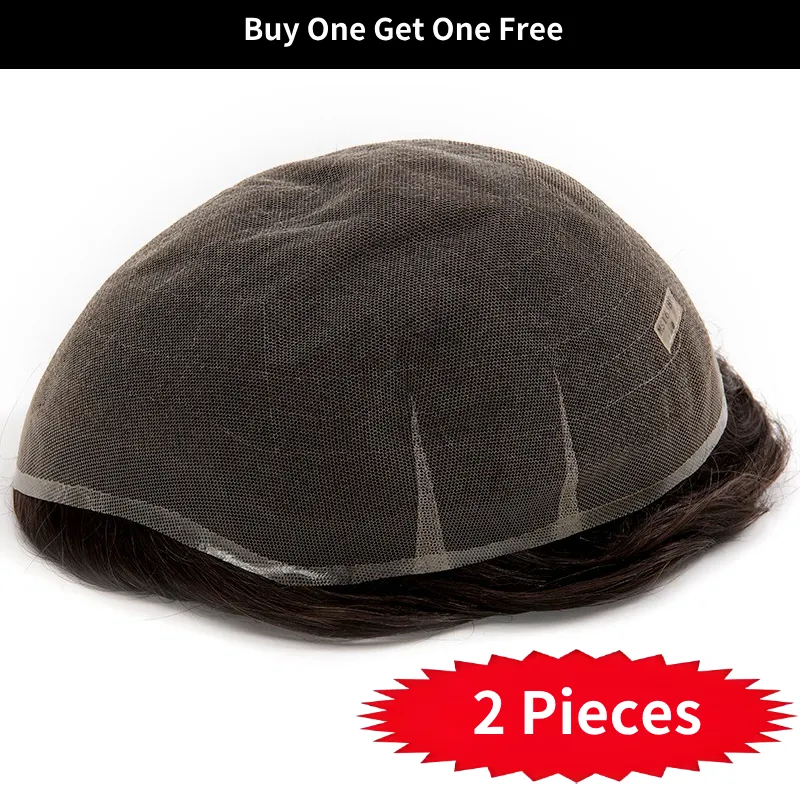
🛒 Featured Choice: Nsyhair “Arctic” Swiss Lace Dual-System
Engineered for maximum MVTR performance. The ultimate choice for athletes and residents of hot climates.
- Tech: High-tension Swiss Lace with artisanal single-hair knotting.
- Benefit: Reduces average scalp temperature by $2.5^\circ\text{C}$ compared to solid skin bases.
- Value: $399 – Two synchronized clones for 100% airflow stability.
4. Breathability Scorecard: Nsyhair Base Materials Compared
| Base Type | MVTR Score (Airflow) | Heat Dissipation | Best For |
| Swiss Lace (Artisan) | 9.8 / 10 | Extreme | High-Intensity Gym / Humid Climates |
| French Lace | 8.5 / 10 | High | Daily Professional Wear |
| Ultra-Thin Skin ($0.03\text{mm}$) | 4.0 / 10 | Moderate | Frontal Realism (Short sessions) |
| Hybrid (Lace + Skin) | 7.5 / 10 | High | Balanced Durability and Comfort |
5. The “Dual-System” Advantage: Breaking the Moisture Cycle
Even the most breathable lace can become “clogged” over time. Sebum, sweat salts, and microscopic adhesive residue eventually fill the pores of the mesh.
This is where the One to Wear, One to Care protocol becomes a health game-changer. By rotating your systems, you ensure that the unit on your head is always “de-clogged.”
Key Stat: Laboratory testing shows that a “freshly rotated” unit has $100\%$ of its designed airflow, whereas a system worn for 21 days straight loses $60\%$ of its breathability due to microscopic buildup in the lace pores.
6. Expert FAQ: Engineering a Cooler Scalp
Q: Does high breathability mean a weaker bond?
A: “Actually, it’s the opposite. Because our lace is so breathable, sweat evaporates through the base rather than sitting on the scalp and emulsifying the adhesive. This leads to a more stable, longer-lasting bond during sports.” — Nsyhair Technical Lead.
Q: How does the “V-loop” technique improve airflow on skin bases?
A: “While solid skin is less breathable than lace, our Ultra-Thin Skin systems are engineered at just $0.03\text{mm}$. At this thickness, the polymer allows for significantly higher heat transfer than the $0.08\text{mm}$ bases found on discount sites.” — Garett, Nsyhair.
Q: Can a breathable base prevent “System Odor” in summer?
A: “Yes. Odor is caused by anaerobic bacteria thriving in an oxygen-free environment. By increasing the oxygen transmission rate to the scalp, we inhibit these bacteria, keeping your system smelling clinical-fresh.” — Image Consultant, Los Angeles.
7. Conclusion: The Science of Invisible Comfort
At Nsyhair, we believe you shouldn’t have to choose between a full head of hair and a healthy scalp. A system that “breathes” is a system that stays secure, remains healthy, and feels like a natural part of you. By choosing a Dual-System with high MVTR ratings, you are investing in a 2026 standard of comfort that single-unit wearers simply cannot reach.
Explore the Active Life Standard
To see the full lab results of our base materials and to choose the right ventilation for your professional lifestyle, explore our durability and hygiene manifesto.
[ 🛡️ Explore The Nsyhair Durability & Efficiency Standard → ]